
#59: Laura Spinney
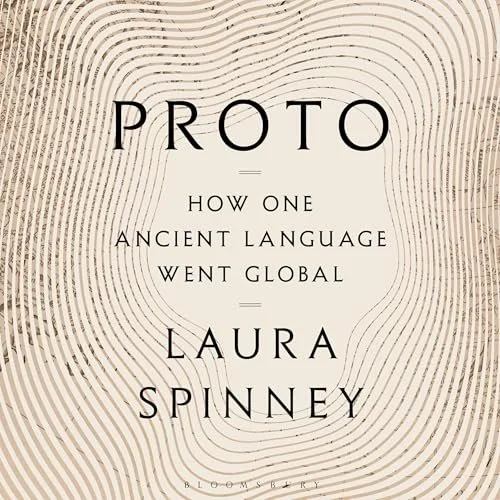
Proto: The Language
that Runs Through Us
Episode Summary
The delightful and engaging Laura Spinney is a science journalist and author of the book Proto. Laura joins the podcast to help us unpack the extraordinary story of the ancient Bronze Age Yamnaya culture, whose linguistic legacy endures today in the family of Indo-European languages. Even though the Yamnaya’s Proto language went extinct without being recorded, its linguistic offspring have survived across millennia, evolving into a multitude of other languages that are alive and well in our time. Some of these many languages are English, Urdu, Russian, Farsi, Bengali, Spanish, Norwegian, and Irish. Proto is also the mother tongue of other languages that have since become extinct, such as Latin, Sanskrit, and Ancient Greek.
With admirable mental dexterity, Laura weaves the complex, multilayered facets of the Proto story. She helps us tackle the core mystery of it all: who were the ancient peoples who spoke Proto that was never written down and hasn’t been uttered in more than 4,000 years, and how is it that their Pontic Steppe culture ended up being the progenitor to a set of languages that are now spoken around the planet?
Armed with the most up-to-date insights from linguistics, archaeology, and genetics, Laura shows us how these disciplines have converged over the last two decades to provide an increasingly clearer, but still evolving portrait. By unearthing DNA, tracing word roots, and studying cultural remnants, science has modeled aspects of this prehistoric period and the Yamnaya peoples, providing a deeper glimpse into the linguistic origins of nearly half of the planet.
This episode concludes by considering the contemporary lessons Proto's themes offer. Migrations, evolving linguistic and genetic demographics, and the nativist and nationalistic reactions to change are familiar motifs. Citing the shifting language demographics in the United States, Spinney reminds us that migration and linguistic change are constant throughout human history rather than aberrations, arguing that only languages and cultures that adapt endure.
This big-picture conversation in our Social Cohesion season invites us to consider the large tides of human history in our quest for cohesion. Spinney’s Proto story shows us how intermixed the current state of affairs already is, asking us to widen our view and our hearts to see beyond apparent differences. The truth is there are vast scales of cultural and linguistic patterns moving through and around us. Proto asks us to open up, let go, and trust the wild and unrelenting change that has defined the human saga across thousands of years and will continue to do so in the coming centuries.

About Laura Spinney
Laura Spinney is a Paris-based writer and science journalist who has written for the Guardian, FT, Nature and Atlantic, among others. She is the author of two novels, one work of fiction in translation, and three books of non-fiction, including her bestselling account of the 1918 ‘Spanish’ flu, Pale Rider. Her new book Proto, the story of the world’s most successful language, was published in 2025.
You can learn more about Laura on her website.